The World Cultural Council (WCC) was founded in Mexico in 1982 with a vision of contributing to a culture that inspires people across the globe to join forces towards a better world, respecting differences between people, promoting progress, and celebrating the achievements of human creativity. Founded by a distinguished group of renowned scientists, scholars, and academic leaders from all continents, the WCC has been at the forefront of celebrating and promoting achievements in various fields of human endeavour.
Its Award Ceremonies recognise outstanding achievement in science, education, and the arts.
The first Award Ceremony took place in Monterrey, Mexico in 1984, when the Albert Einstein World Award of Science was granted to Guatemalan Dr. Ricardo Bressani for his pioneering work to improve nutrition in Latin America.
Since 1984, these prestigious award ceremonies have been hosted by leading universities and institutions across the planet, changing venue every year to remain truly global.
Membership of the WCC has grown from the initial group of 124 to encompass 255 top academics from 55 countries, including several Nobel laureates. WCC members constitute the Interdisciplinary Committee which decide on the winners for each year’s awards.
The World Cultural Council has had an illustrious journey over the years, consistently growing and transforming into the respected organization that it is today. Spearheading the recognition of outstanding individuals as role models and their contributions to the heritage of humankind, the Council has emerged as a significant force in the promotion of excellence, based on principles of tolerance, diversity and respect for the environment.
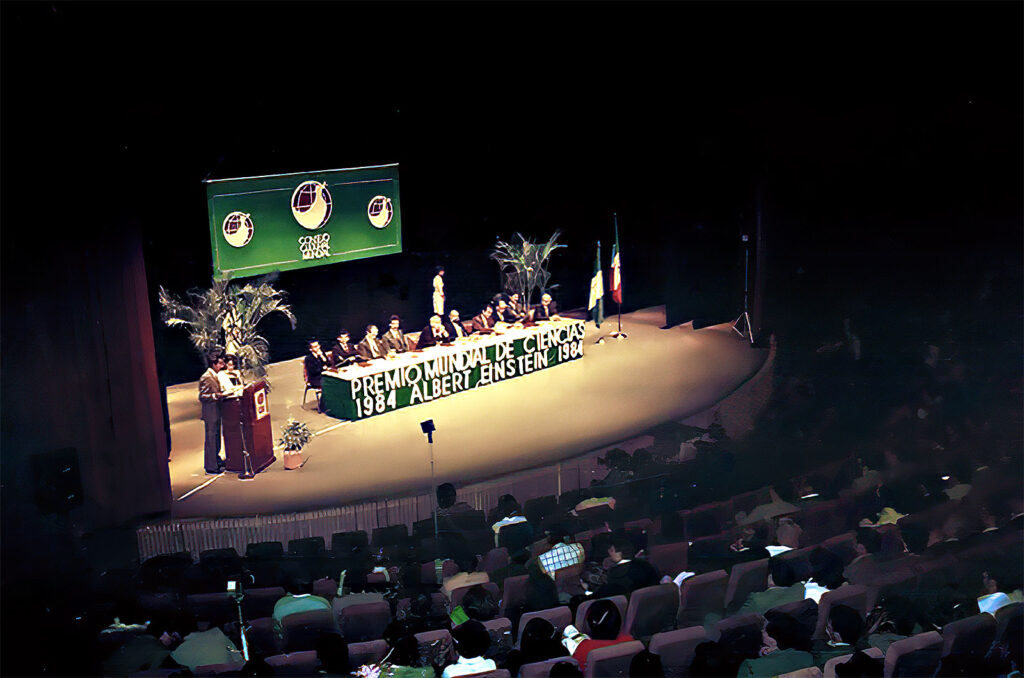
The first World Cultural Council Award Ceremony was held in 1984 in Monterrey, Mexico. The Albert Einstein World Award of Science was granted to Guatemalan Dr. Ricardo Bressani.
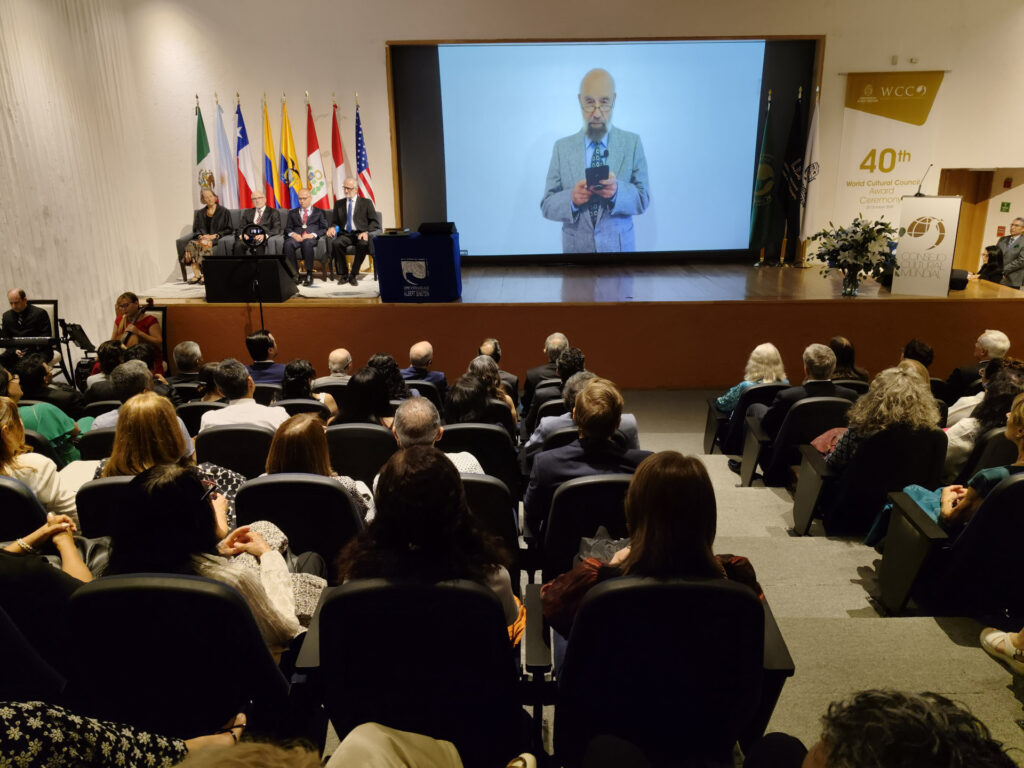
In 2025, the 40th WCC Award Ceremony was held at the Museo de Arte Contemporáneo de Monterrey, Mexico. Prof. Mercouri Kanatzidis was awarded the Albert Einstein World Award of Science.
The first World Cultural Council Award Ceremony was held in 1984 in Monterrey, Mexico. The Albert Einstein World Award of Science was granted to Guatemalan Dr. Ricardo Bressani.
In 2025, the 40th WCC Award Ceremony was held at the Museo de Arte Contemporáneo de Monterrey, Mexico. Prof. Mercouri Kanatzidis was awarded the Albert Einstein World Award of Science.
Founding Members of the World Cultural Council
(Interdisciplinary Committee)
The WCC was created on the inspiration of 124 distinguished personalities from the five continents.
- Christian B. Anfinsen (USA)
- Werner Arber (Switzerland)
- James Baddiley (UK)
- M. Balasegaram (Malaysia)
- Frank Barnaby (UK)
- Christiaan Barnard (S. Africa)
- Colin Blakemore (UK)
- Aage N. Bohr (Denmark)
- Norman Borlaug (USA)
- Harold G. Callan (UK)
- Andre F. Cournand (USA)
- William J. Darby (USA)
- Eduardo de Robertis (Argentina)
- Cornelis de Jager (The Netherlands)
- Guy Blaudin de The (France)
- Jean Francois Denisse (France)
- Venancio Deulofeu (Argentina)
- Frank J. Dixon (USA)
- Richard S. Doll (UK)
- Audouin Dollfus (France)
- Jacques E. Dubois (France)
- Gerald Durrell (UK)
- Francisco J. Dy (Philippines)
- John C. Eccles (Australia)
- Paul Ehrlich (USA)
- Manfred Eigen (Germany)
- Mohammed El Fasi (Morocco)
- Ernest L. Eliel (USA)
- Kenneth O. Emergy (USA)
- Hans J. Eysenck (UK)
- Don W. Fawcett (USA)
- David J. Finney (UK)
- Val L. Fitch (USA)
- Carl G. Gahmberg (Finland)
- Alfred D. Hershey (USA)
- Gerhard Herzberg (Canada)
- David H. Hubel (USA)
- Osmo H. Järvi (Finland)
- Reginald V. Jones (UK)
- Adrian Kantrowitz (USA)
- Nathan O. Kaplan (USA)
- Leo A. Kaprio (Finland)
- Vasso Karageorghis (Cyprus)
- Peter E. Kent (UK)
- Donald W. Kerst (USA)
- Seymour S. Kety (USA)
- Prem N. Kirpal (India)
- Georges B. Koelle (USA)
- Walther Manshard (Germany)
- Georges Mathe (France)
- William D. Mc Elroy (USA)
- Henry McIlwain (UK)
- John McMichael (UK)
- Jerrold Meinwald (USA)
- Harry Melville (UK)
- Desmond J. Morris (UK)
- Giuseppe Moruzzi (Italy)
- Nevill Mott (UK)
- Vernon B. Mountcastle (USA)
- Robert S. Mulliken (USA)
- Walter H. Munk (USA)
- Ilie Murgulescu (Rumania)
- Jayant V. Narlikar (India)
- Louis E. F. Neel (France)
- Yuval Ne´eman (Israel)
- Bernhard H. Neumann (Australia)
- William A. Nierenberg (USA)
- Marshall W. Nirenberg (USA)
- George E. Palade (USA)
- Arthur B. Pardee (USA)
- David Phillips (UK)
- Jacques Piccard (Switzerland)
- Jens J. Pindborg (Denmark)
- Comlan A. A. Quenum (Benin)
- Hermann Rahn (USA)
- G. N. Ramachandran (India)
- Gunnar Randers (Norway)
- Chintamani N. R. Rao (India)
- Rex Richards (UK)
- Jean Rosch (France)
- Abraham J. A. Roux (S. Africa)
- Stanley K. Runcorn (UK)
- Donald H. Sadler (UK)
- Hakim Mohammed Said (Pakistan)
- Nobufusa Saito (Japan)
- Abdus Salam (Pakistan)
- Stuart J. Saunders (S. Africa)
- Menahem M. Schiffer (USA)
- William G. Schneider (Canada)
- Glenn T. Seaborg (USA)
- Ernest R. Sears (USA)
- Frederick Seitz (USA)
- Leonard T. Skeggs (USA)
- Stefan Slopek (Poland)
- George J. Smets (Belgium)
- George D. Snell (USA)
- Leonard Sosnowski (Poland)
- Roger W. Sperry (USA)
- Lyman Spitzer (USA)
- Frederick Stewart (UK)
- Heikki Suomalainen (Finland)
- Pol Swings (Belgium)
- Charles Tanford (USA)
- Henry Taube (USA)
- John M. Tedder (UK)
- Edward Teller (USA)
- Howard Temin (USA)
- Harold Thompson (UK)
- Peter C. Thonemann (UK)
- Phillip V. Tobias (S. Africa)
- Alexander R. Todd (UK)
- J. Peter Toennies (USA)
- Andrzej Trautman (Poland)
- Jean L. F. Tricart (France)
- Ioan Ursu (Rumania)
- Constantin Vago (France)
- Rafael Valero (Mexico)
- Eugene Van Tamelen (USA)
- Ulf S. Von Euler (Sweden)
- Alan Walsh (UK)
- William J. Whelan (UK)
- Karel F. Wiesner (Canada)
- Rosalyn S. Yalow (USA)
- John Z. Young (UK)