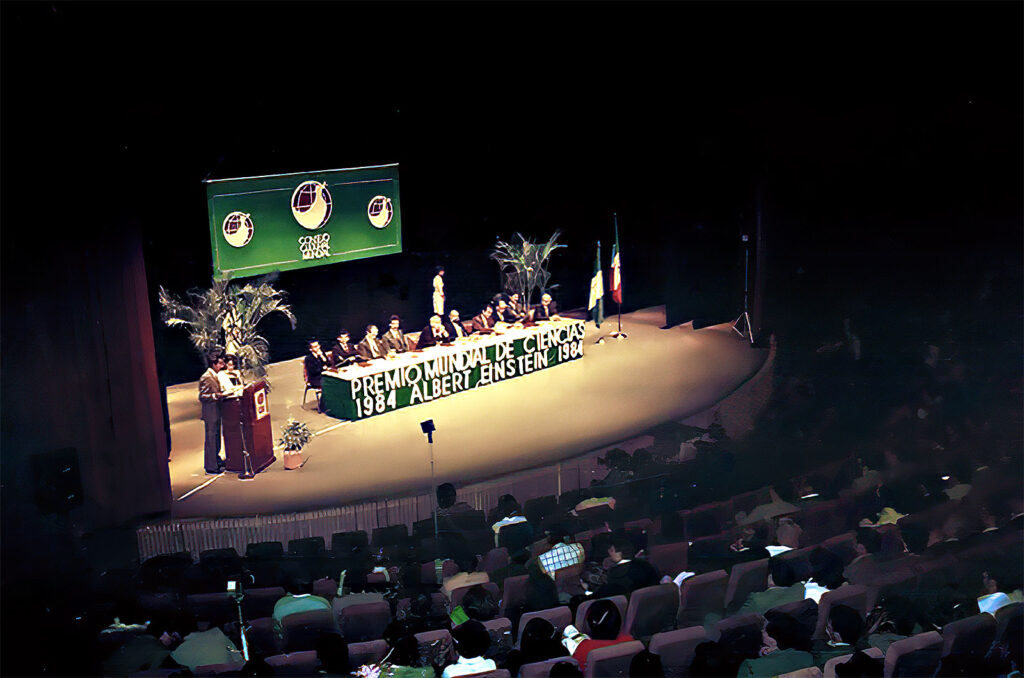
The first World Cultural Council Award Ceremony was held in 1984 in Monterrey, Mexico. The Albert Einstein World Award of Science was granted to Guatemalan Dr. Ricardo Bressani.
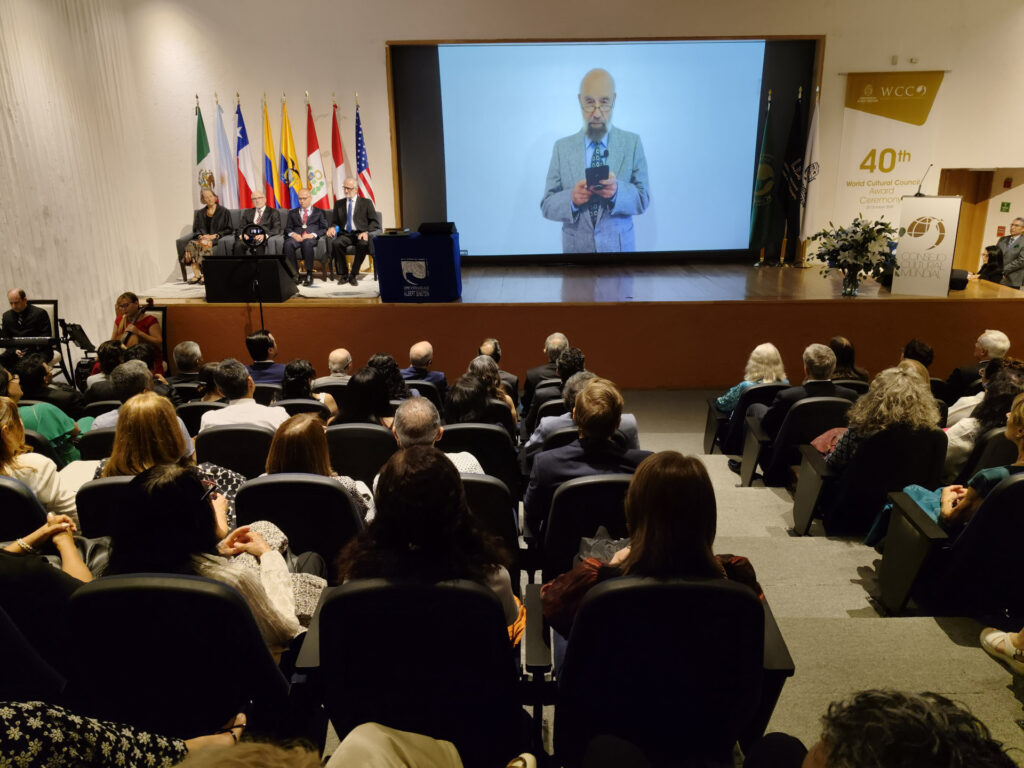
In 2025, the 40th WCC Award Ceremony was held at the Museo de Arte Contemporáneo de Monterrey, Mexico. Prof. Mercouri Kanatzidis was awarded the Albert Einstein World Award of Science.
The first World Cultural Council Award Ceremony was held in 1984 in Monterrey, Mexico. The Albert Einstein World Award of Science was granted to Guatemalan Dr. Ricardo Bressani.
In 2025, the 40th WCC Award Ceremony was held at the Museo de Arte Contemporáneo de Monterrey, Mexico. Prof. Mercouri Kanatzidis was awarded the Albert Einstein World Award of Science.
Founding Members of the World Cultural Council
(Interdisciplinary Committee)
The WCC was created on the inspiration of 124 distinguished personalities from the five continents.
- Christian B. Anfinsen (USA)
- Werner Arber (Switzerland)
- James Baddiley (UK)
- M. Balasegaram (Malaysia)
- Frank Barnaby (UK)
- Christiaan Barnard (S. Africa)
- Colin Blakemore (UK)
- Aage N. Bohr (Denmark)
- Norman Borlaug (USA)
- Harold G. Callan (UK)
- Andre F. Cournand (USA)
- William J. Darby (USA)
- Eduardo de Robertis (Argentina)
- Cornelis de Jager (The Netherlands)
- Guy Blaudin de The (France)
- Jean Francois Denisse (France)
- Venancio Deulofeu (Argentina)
- Frank J. Dixon (USA)
- Richard S. Doll (UK)
- Audouin Dollfus (France)
- Jacques E. Dubois (France)
- Gerald Durrell (UK)
- Francisco J. Dy (Philippines)
- John C. Eccles (Australia)
- Paul Ehrlich (USA)
- Manfred Eigen (Germany)
- Mohammed El Fasi (Morocco)
- Ernest L. Eliel (USA)
- Kenneth O. Emergy (USA)
- Hans J. Eysenck (UK)
- Don W. Fawcett (USA)
- David J. Finney (UK)
- Val L. Fitch (USA)
- Carl G. Gahmberg (Finland)
- Alfred D. Hershey (USA)
- Gerhard Herzberg (Canada)
- David H. Hubel (USA)
- Osmo H. Järvi (Finland)
- Reginald V. Jones (UK)
- Adrian Kantrowitz (USA)
- Nathan O. Kaplan (USA)
- Leo A. Kaprio (Finland)
- Vasso Karageorghis (Cyprus)
- Peter E. Kent (UK)
- Donald W. Kerst (USA)
- Seymour S. Kety (USA)
- Prem N. Kirpal (India)
- Georges B. Koelle (USA)
- Walther Manshard (Germany)
- Georges Mathe (France)
- William D. Mc Elroy (USA)
- Henry McIlwain (UK)
- John McMichael (UK)
- Jerrold Meinwald (USA)
- Harry Melville (UK)
- Desmond J. Morris (UK)
- Giuseppe Moruzzi (Italy)
- Nevill Mott (UK)
- Vernon B. Mountcastle (USA)
- Robert S. Mulliken (USA)
- Walter H. Munk (USA)
- Ilie Murgulescu (Rumania)
- Jayant V. Narlikar (India)
- Louis E. F. Neel (France)
- Yuval Ne´eman (Israel)
- Bernhard H. Neumann (Australia)
- William A. Nierenberg (USA)
- Marshall W. Nirenberg (USA)
- George E. Palade (USA)
- Arthur B. Pardee (USA)
- David Phillips (UK)
- Jacques Piccard (Switzerland)
- Jens J. Pindborg (Denmark)
- Comlan A. A. Quenum (Benin)
- Hermann Rahn (USA)
- G. N. Ramachandran (India)
- Gunnar Randers (Norway)
- Chintamani N. R. Rao (India)
- Rex Richards (UK)
- Jean Rosch (France)
- Abraham J. A. Roux (S. Africa)
- Stanley K. Runcorn (UK)
- Donald H. Sadler (UK)
- Hakim Mohammed Said (Pakistan)
- Nobufusa Saito (Japan)
- Abdus Salam (Pakistan)
- Stuart J. Saunders (S. Africa)
- Menahem M. Schiffer (USA)
- William G. Schneider (Canada)
- Glenn T. Seaborg (USA)
- Ernest R. Sears (USA)
- Frederick Seitz (USA)
- Leonard T. Skeggs (USA)
- Stefan Slopek (Poland)
- George J. Smets (Belgium)
- George D. Snell (USA)
- Leonard Sosnowski (Poland)
- Roger W. Sperry (USA)
- Lyman Spitzer (USA)
- Frederick Stewart (UK)
- Heikki Suomalainen (Finland)
- Pol Swings (Belgium)
- Charles Tanford (USA)
- Henry Taube (USA)
- John M. Tedder (UK)
- Edward Teller (USA)
- Howard Temin (USA)
- Harold Thompson (UK)
- Peter C. Thonemann (UK)
- Phillip V. Tobias (S. Africa)
- Alexander R. Todd (UK)
- J. Peter Toennies (USA)
- Andrzej Trautman (Poland)
- Jean L. F. Tricart (France)
- Ioan Ursu (Rumania)
- Constantin Vago (France)
- Rafael Valero (Mexico)
- Eugene Van Tamelen (USA)
- Ulf S. Von Euler (Sweden)
- Alan Walsh (UK)
- William J. Whelan (UK)
- Karel F. Wiesner (Canada)
- Rosalyn S. Yalow (USA)
- John Z. Young (UK)